Someday I’ll Stop Procrastinating

( I started this last Thursday) 

It’s been a long time since I’ve written.  Honestly, I have the most difficult time getting started writing.  It’s like stage fright: my stomach gets nervous, I pace, my breathing becomes shallow and my skull feels like it’s being squeezed between my temples.  Sorta like George Castanza when he’s confronted with something he doesn’t want to admit to, just before he gets angry.  So I put it off.  Again.  But not this time!

Anyway, I have been working on a Kickstarter project since June.  What is Kickstarter?  To quote from their website, http://www.kickstarter.com:

  1. “What’s Kickstarter?

    Kickstarter is a funding platform for creative projects. Everything from films, games, and music to art, design, and technology. Kickstarter is full of ambitious, innovative, and imaginative projects that are brought to life through the direct support of others.

    Since our launch on April 28, 2009, over $350 million has been pledged by more than 2.5 million people, funding more than 30,000 creative projects. If you like stats, there’s lots more here.

  2. How does Kickstarter work?

    Thousands of creative projects are funding on Kickstarter at any given moment. Each project is independently created and crafted by the person behind it. The filmmakers, musicians, artists, and designers you see on Kickstarter have complete control and responsibility over their projects. They spend weeks building their project pages, shooting their videos, and brainstorming what rewards to offer backers. When they’re ready, creators launch their project and share it with their community.

    Every project creator sets their project’s funding goal and deadline. If people like the project, they can pledge money to make it happen. If the project succeeds in reaching its funding goal, all backers’ credit cards are charged when time expires. If the project falls short, no one is charged. Funding on Kickstarter is all-or-nothing.”

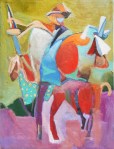
    My project will be to paint 91 paintings of Don Quixote, The Man of LaMancha, in 91 days, and to raise $3000 in order to do it. The rewards will be drawings, paintings and giclee prints.  The non-procrastinational launch date for my Kickstarter project is October 18.  I will then have 30 days to reach my goal.
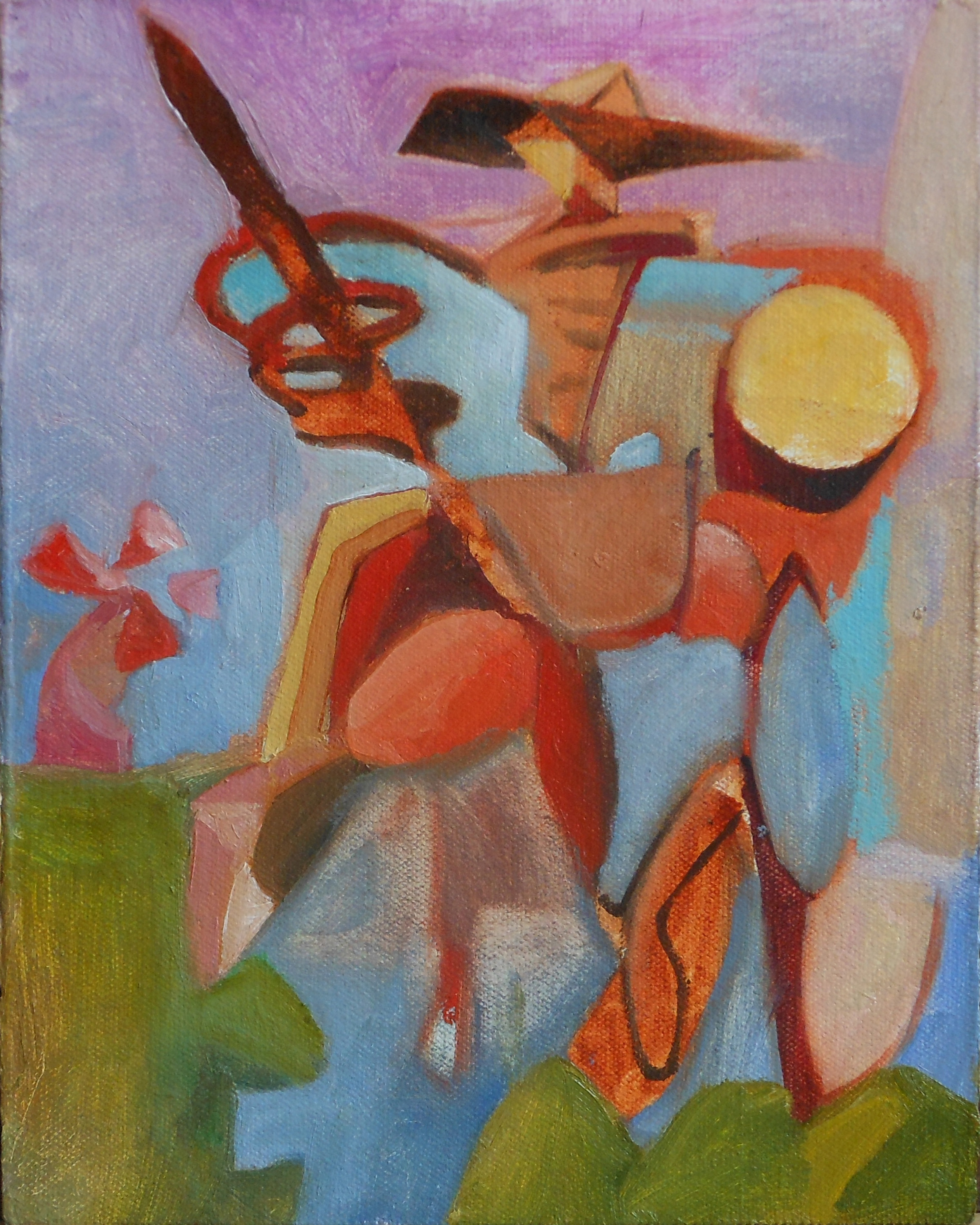
    Why Don Quixote?          Why 91 paintings             in 91 days?Don Quixote of La Mancha is a great analogy for the principled and unrelenting life of an artist.  Pursuing personal vision regardless of critical opinion is a chief tenet of any artist.  I am not the first to take on Miguel de Cervantes’ fictional protagonist, nor will I be the last.  Pursuing “The Impossible Dream” is a timeless theme that has beckoned artists of all stripes.

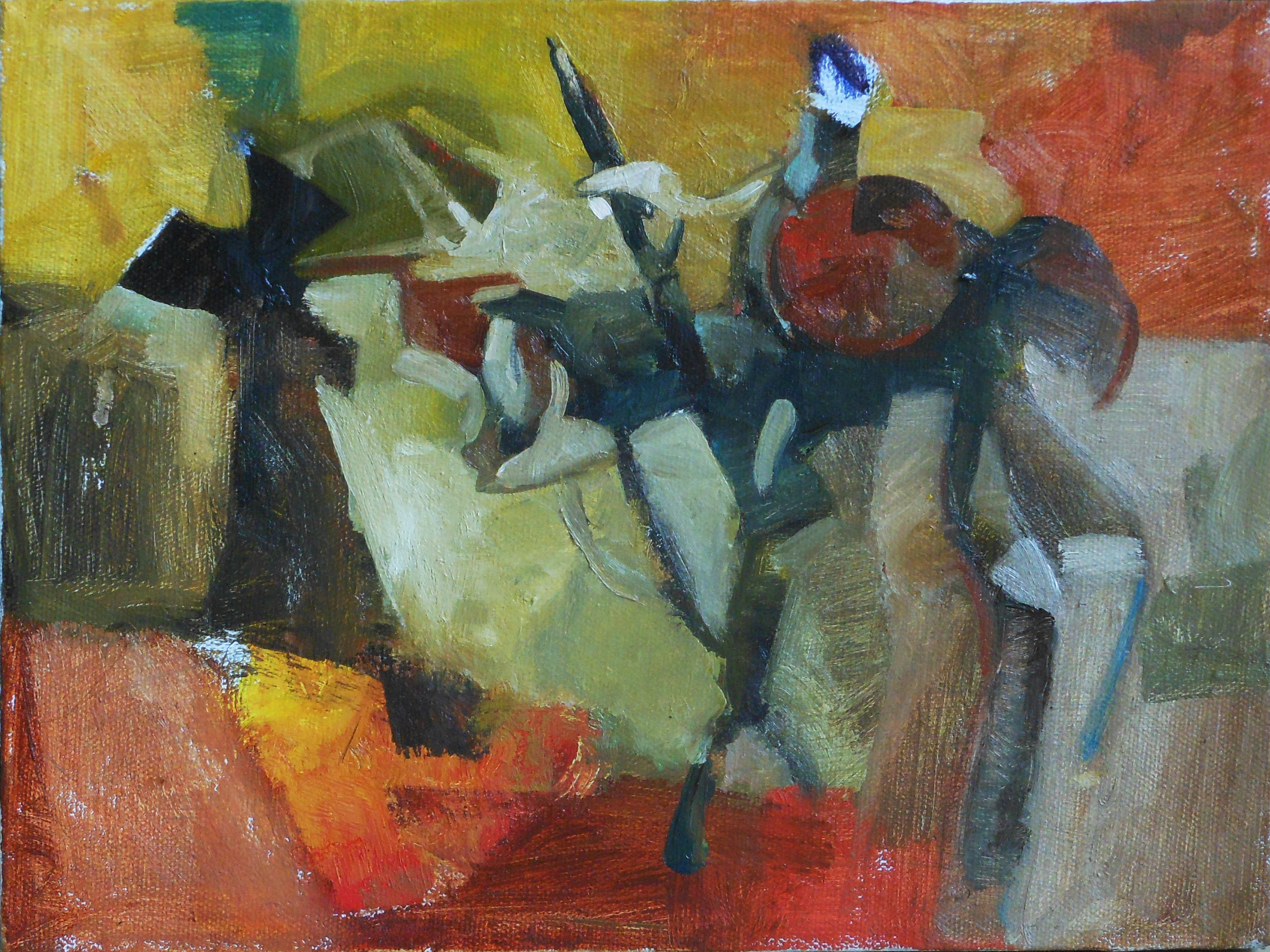
    My project is to to create sixteen paintings featuring the character of “Don Quixote of La Mancha” ranging from mid-size to large, along with twenty-five small paintings and fifty drawings and watercolors in just over three months.  That’s actually 91 pieces of art in 91 days, but it’s much more catchy to say  “91 Paintings in 91 Days.”
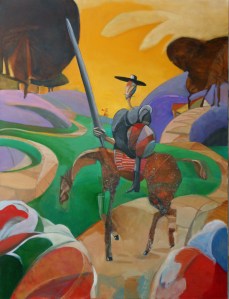
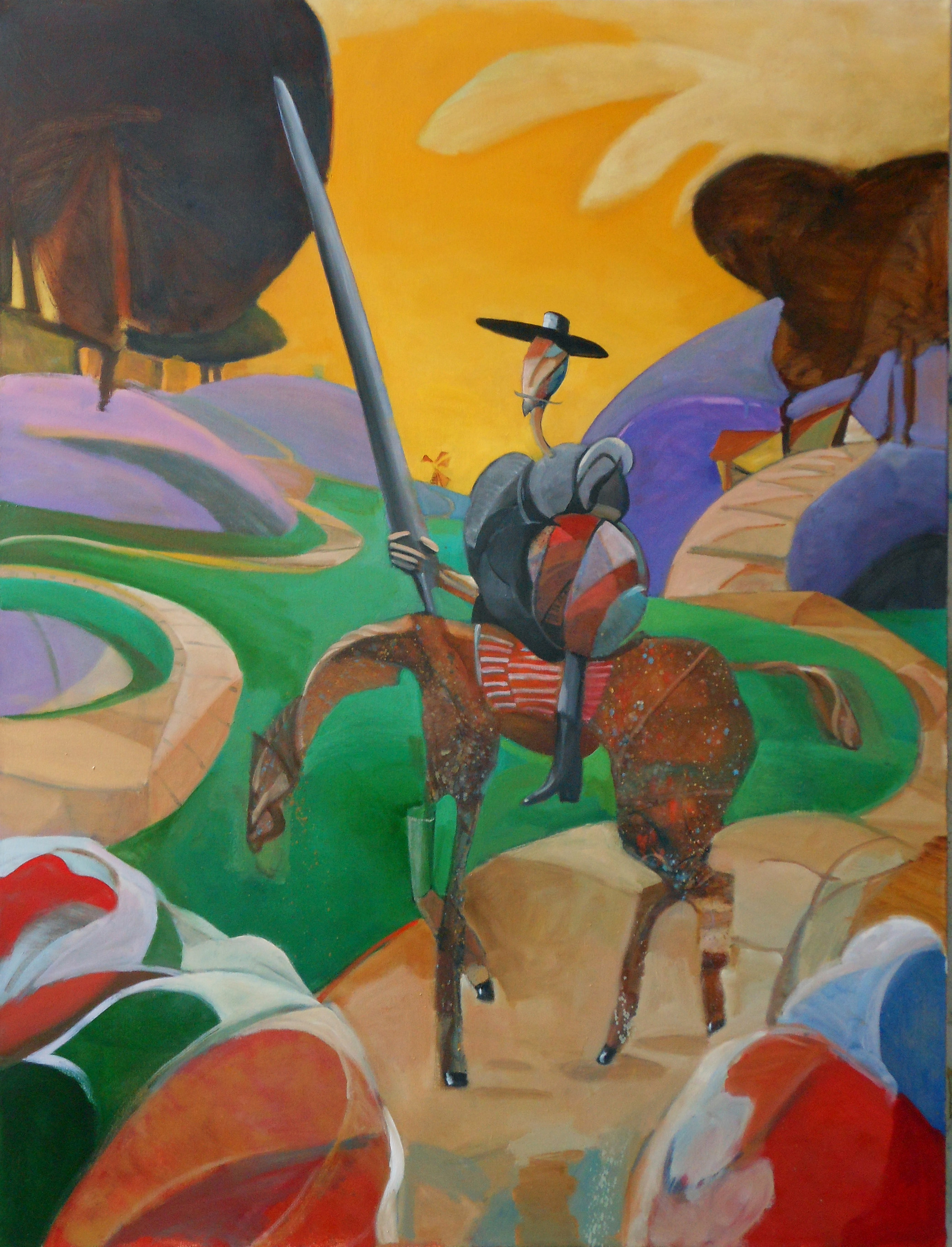
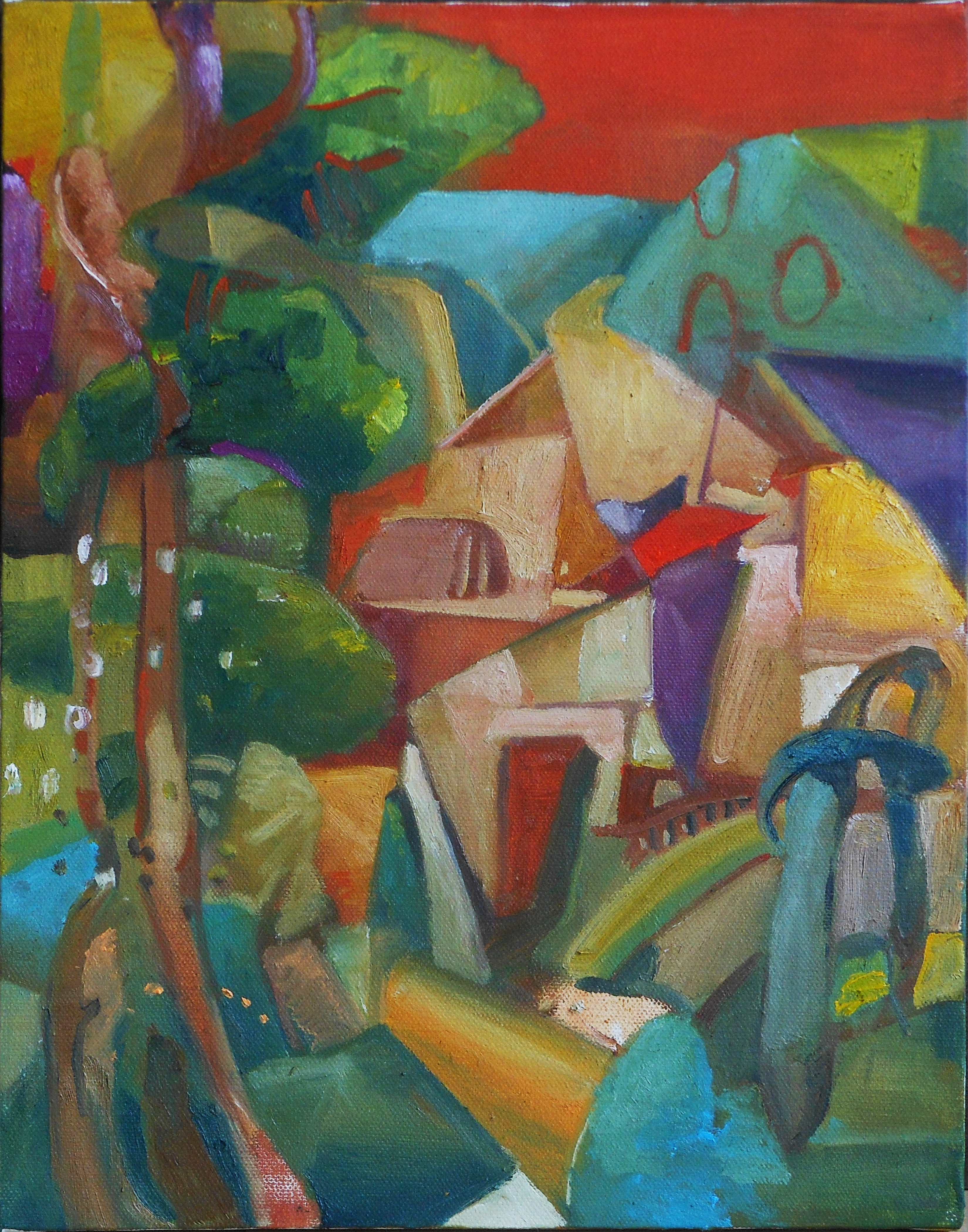
    “Don Quixote Encounters Pigrims On the Road” oil on canvas, 48 x 36″

    As for the style change from persnickety realism to cartoon-ish Cubism?  In a word: Creativity.  In a second word: Fun.

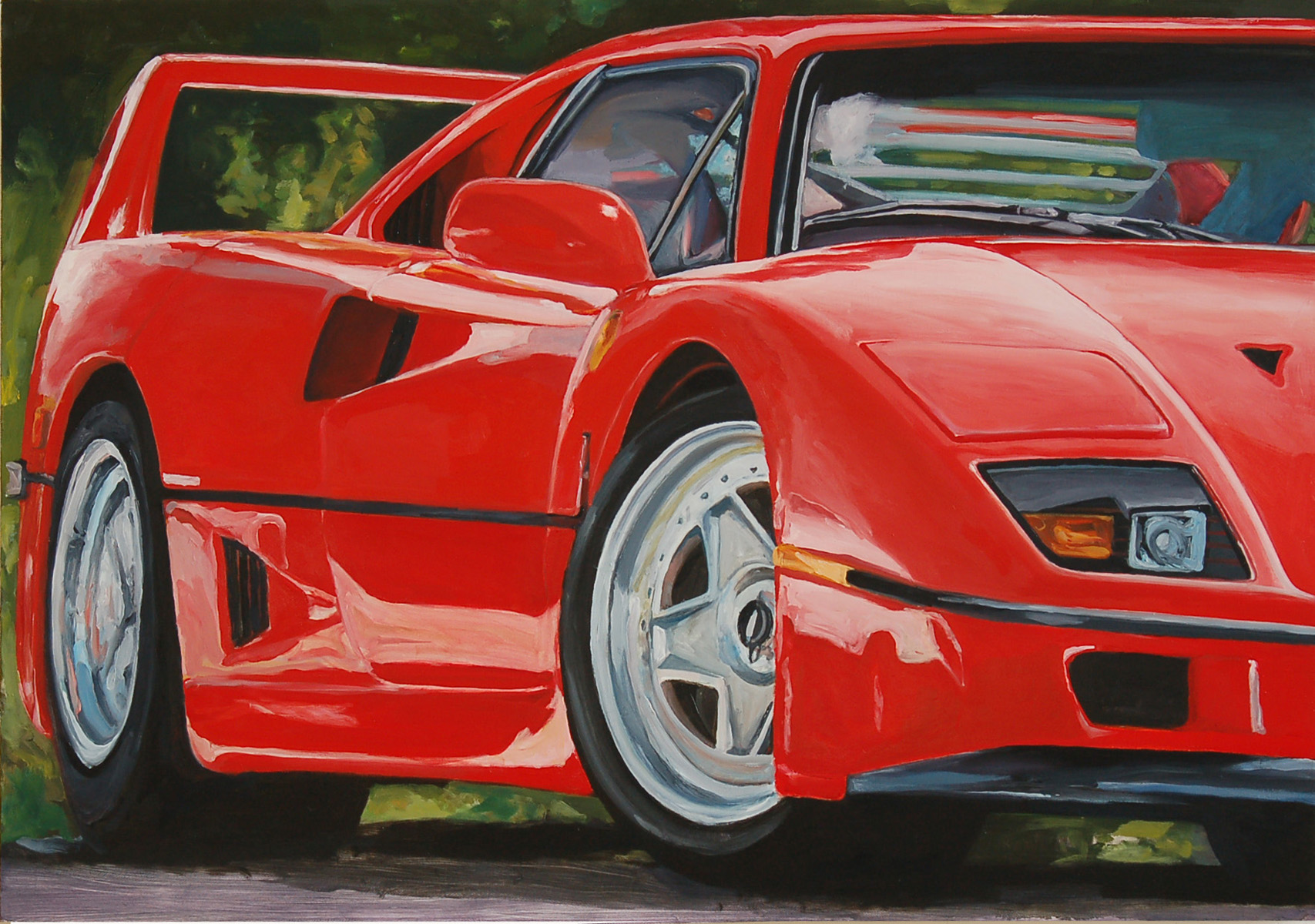
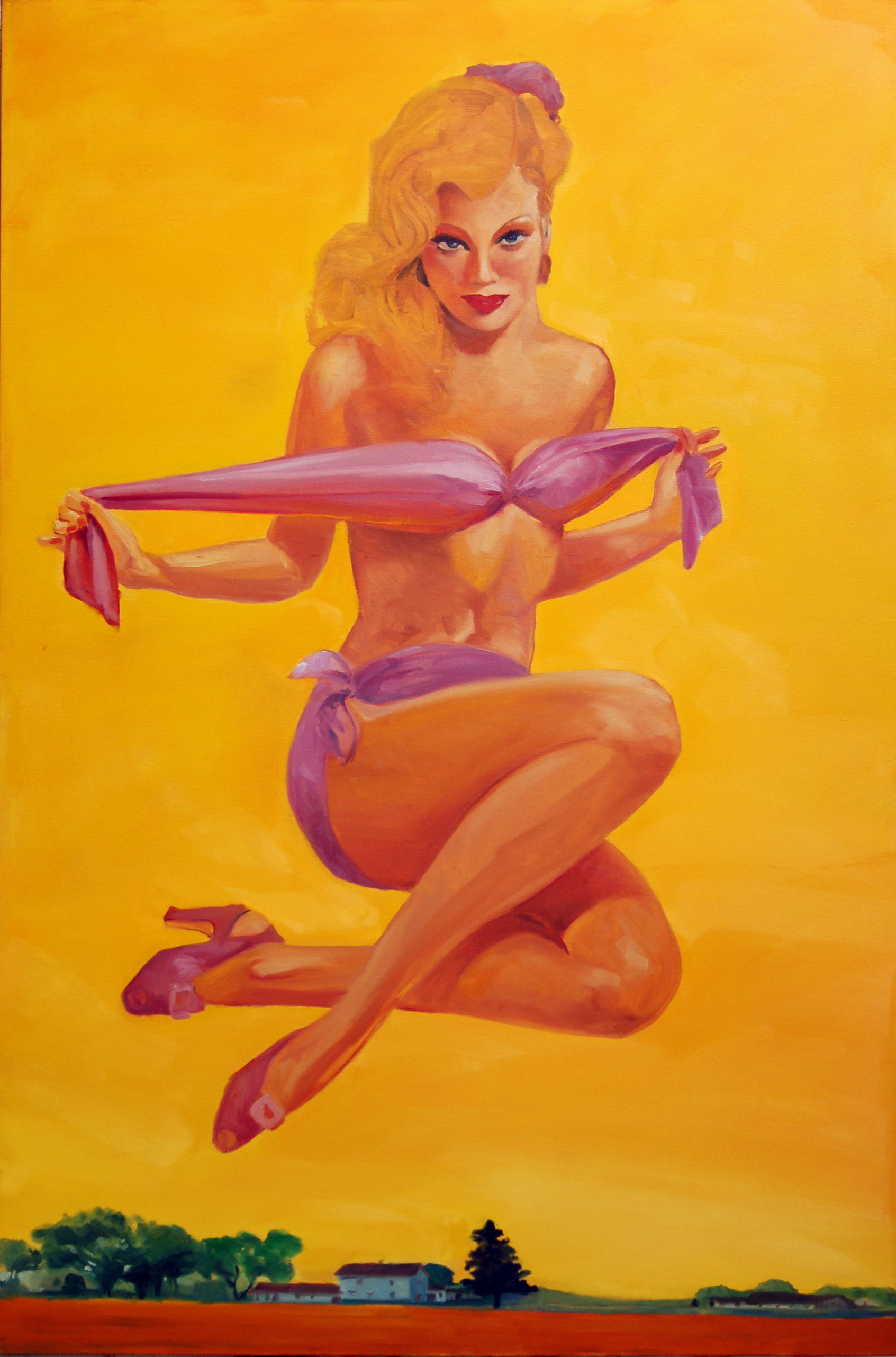
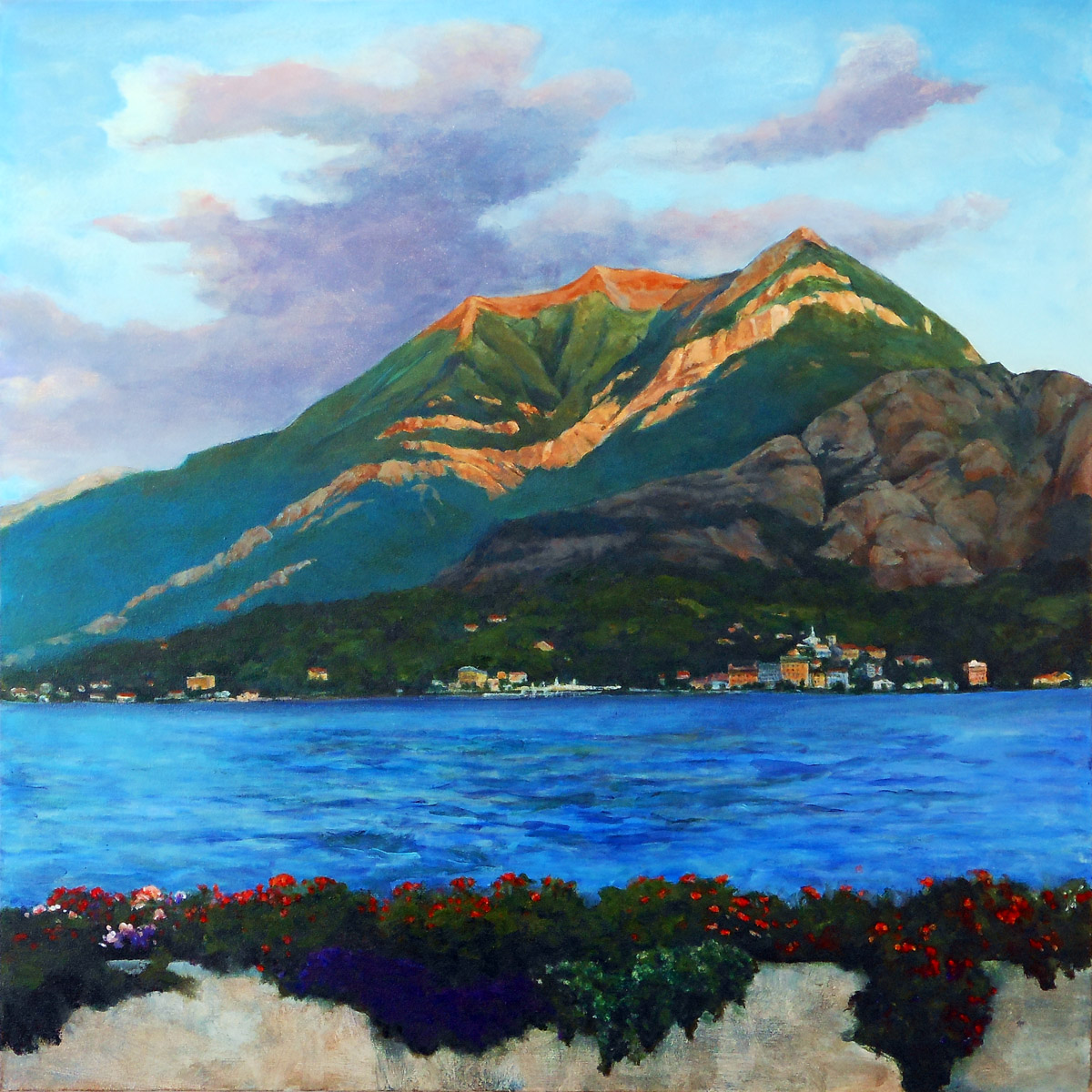
    Painting highly realistic subjects became too restrictive for me. The paintings of  cars, or women, or places were always meant as an homage to honor the beauty of the subject, and a strict fidelity to  the image was the best way to do that.
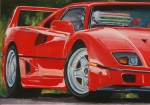
    oil on canvas, 24 x 34″

    To paint that realistically became like an athletic endeavor,  requiring focus and discipline with a strong dose of competitiveness just to see if I could do it.

    Once I knew I could continue painting them, I lost the need to.
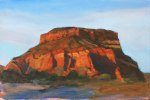
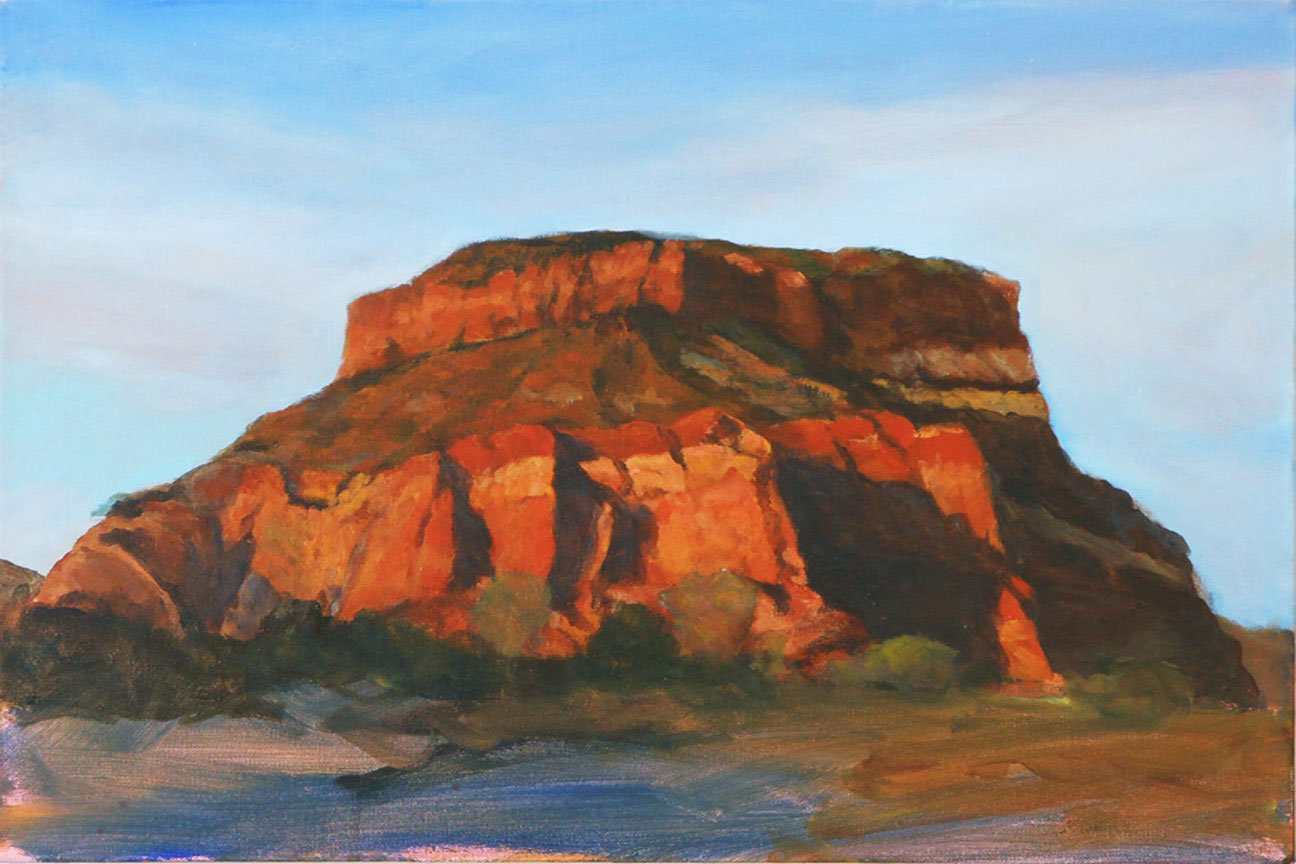
    Strange and wonderful rock outcropping along I-40 in NM. acrylic on canvas 18 x 2

    Doing your own marketing is the worst part of this job.  “Good luck with your career…” is a terrible and cruel phrase to hear.

    I needed to be able to paint without the limits that realism  demanded, and cubism is a method that requires                 throwing fidelity to the image out the window.  Psychological and
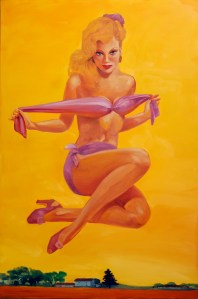
    emotional truths (subjective as they are) are the goal, along with a flair for the decorative.


    If art is about holding a mirror to society, then Cubism is about holding up a hall of carnival mirrors for us to find our true reflection.
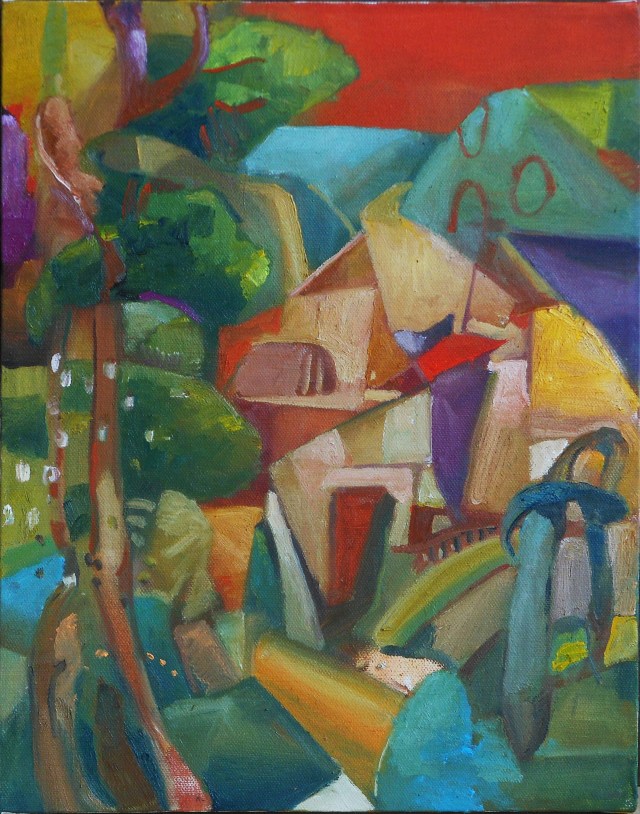
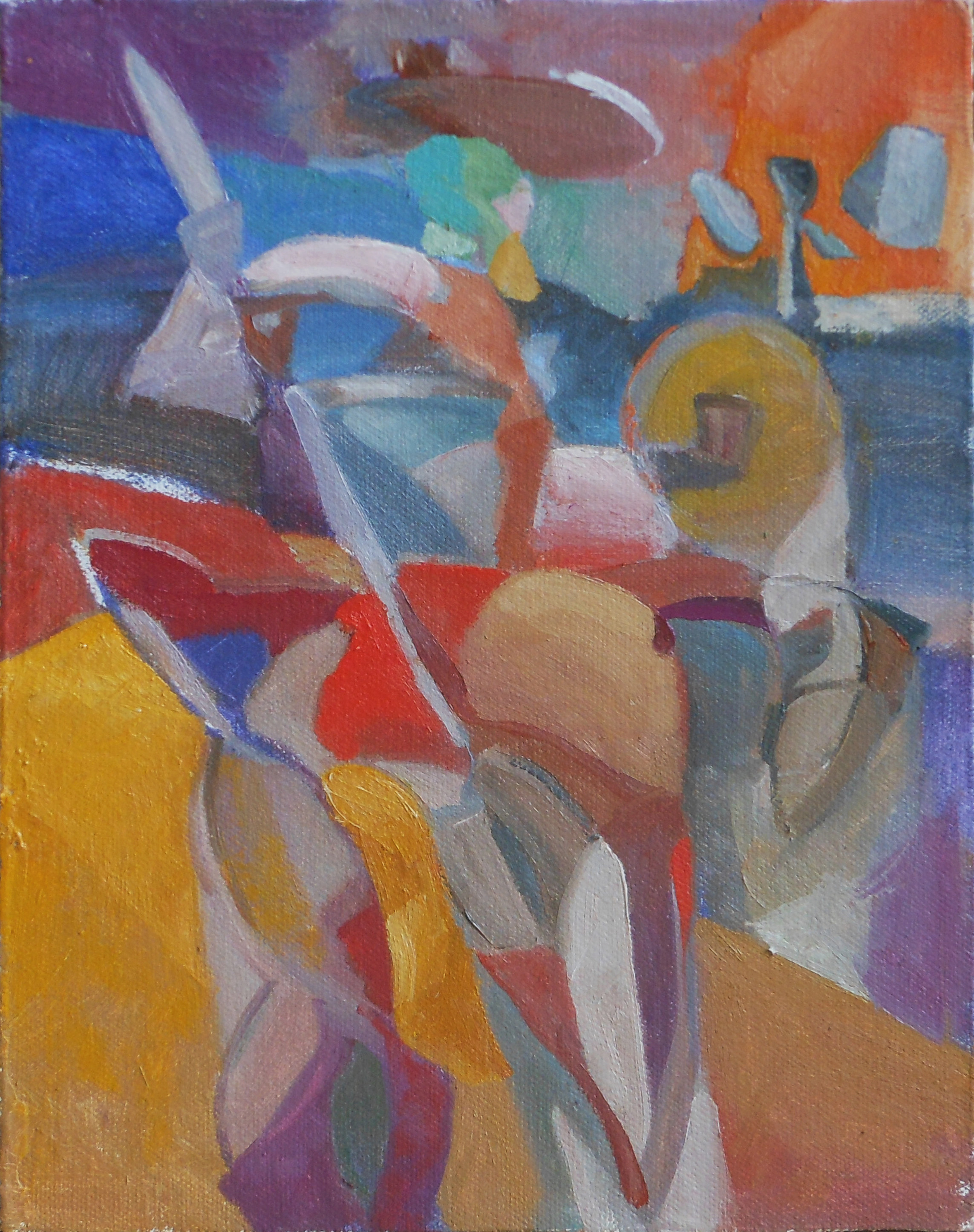
    “Cubist Village Road” 8″ x 10″ oil on canvas on panel

    Actually Cubism was originally meant to present objects the way they look as you move around them, so you’re seeing a dynamic image in space/time represented on a 2-D surface.  The process is to take apart (deconstruct) an image into it’s simplest forms then re-present them in an original way to express movement, and how the artists feels. At the time it was radical to  venture so far from the objective reality around us as to include the hand of the artist as every bit as important as the subject matter.
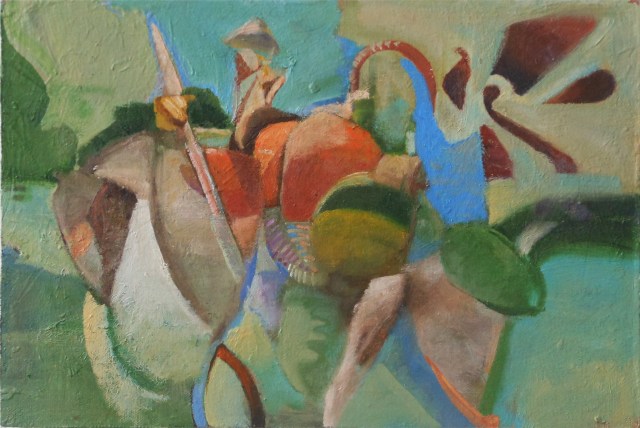
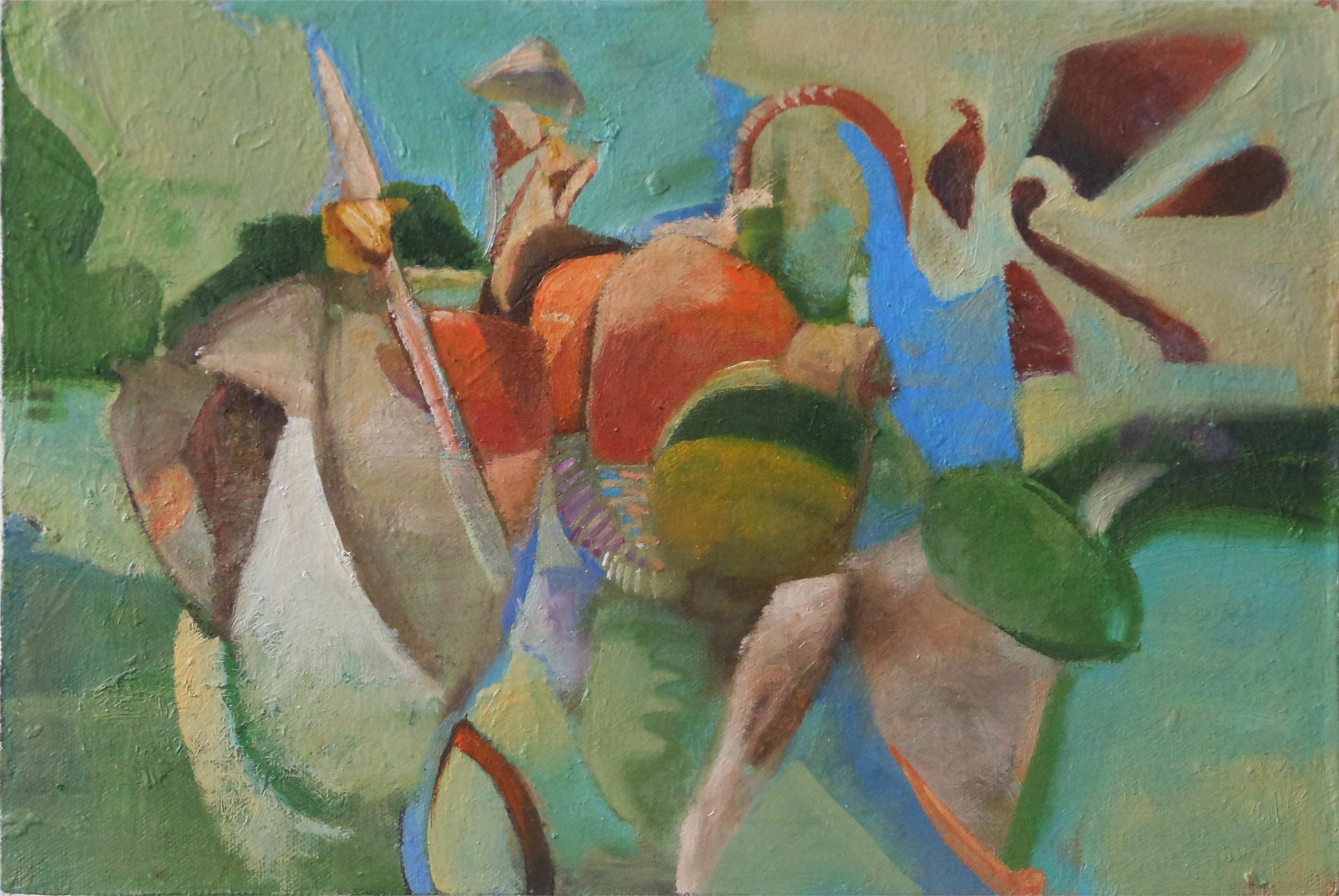
    “Don Quixote Crossing the Charles” 9″ x 13″ oil on panel 2012
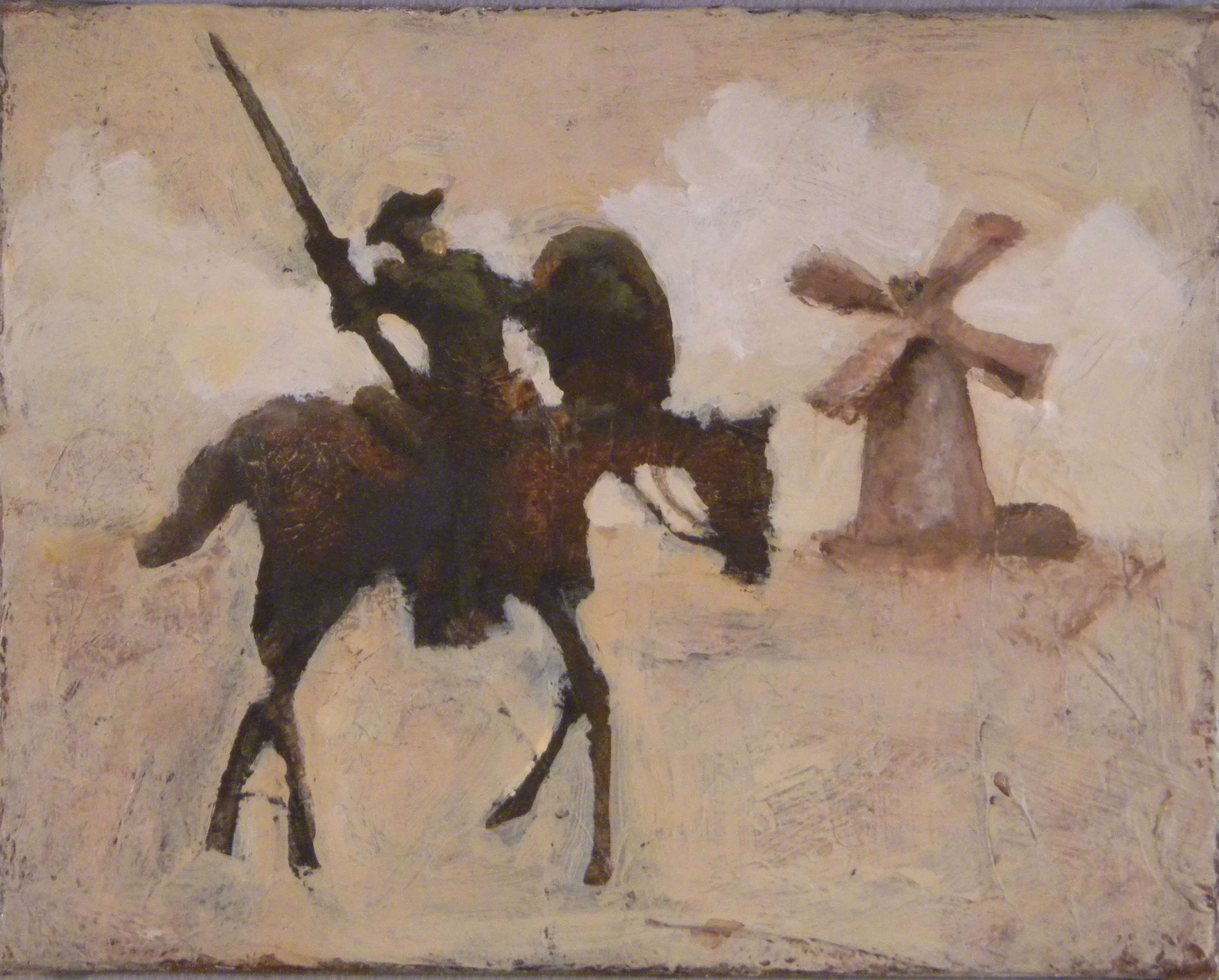
Posted in Events, Paintings | 2 Comments

Art I Like

I got a an email about this show in Santa Fe from a friend, but I was back in Mass. and didn’t see the show.  After looking at the work online, I’m thinking that this would be one show that if I could I would fly specifically to see.

http://gebertcontemporary.com/exhibitions/68/

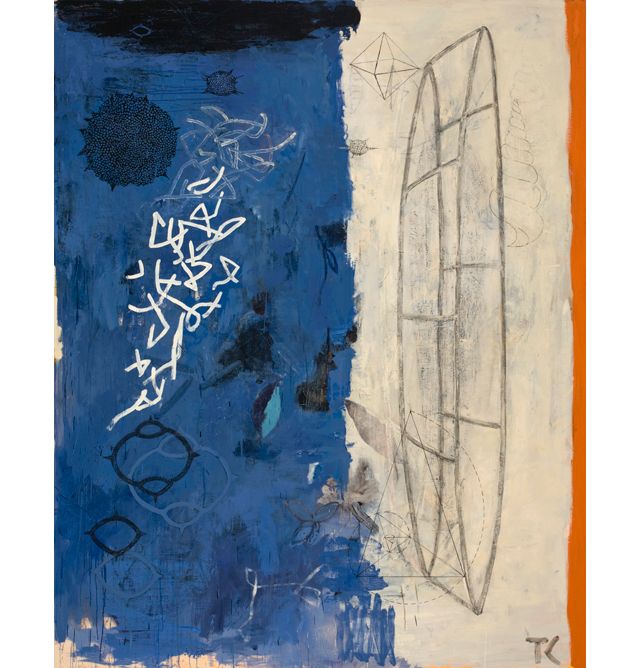
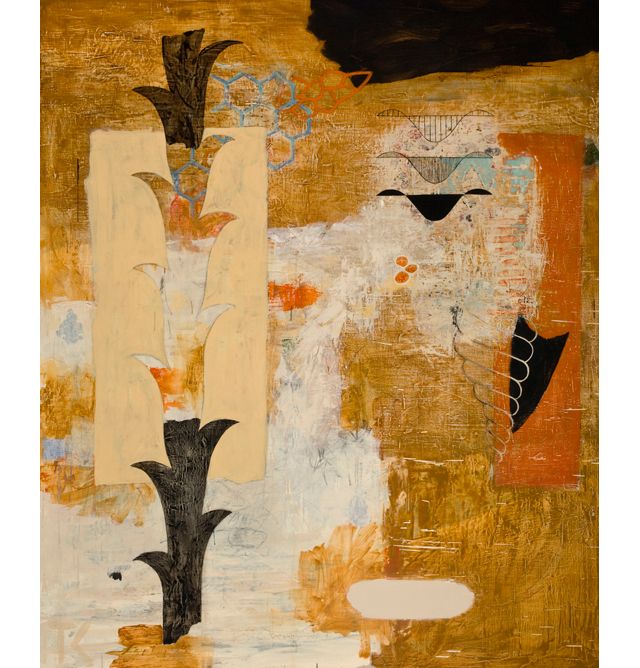
"Madremanya"

“Madremanya” by Tim Craighead
Oil, alkyd, and casein on linen
72 X 60 inches

I’ve seen Tim Craighead’s work before, over the past 10 – 15 years at the Gerald Peters Gallery in Santa Fe. I’ve always liked it, from the first time I saw them. I’ve mostly seen the paintings on paper, though I did see large paintings in a show years ago.

I love these paintings.  I often find that abstract paintings have little relevance outside of the artist’s mind.  Granted, I do like a story line or a narrative of some kind, and abstraction seems too arbitrary and the point the artist is making escapes me.  I do like abstraction, but bot all of it anymore than I would like all of realistic painting.

Why do I like these?  They are so painterly: the variety of mark-making and line quality, the movement around & within the painting, the color harmonies and discords, patterns that emerge just long enough to dissolve as you start to follow them… and the surprises. These paintings continue surprising me the more I keep looking.

For example the scrim of white marks swimming up the center of the blue.  It could be read that the idea of water is trying to reach the idea of a boat.

I think it’s true for most of us that if we are given a picture we look for words to describe it, and if we are given words we conjure the pictures that the words elicit.

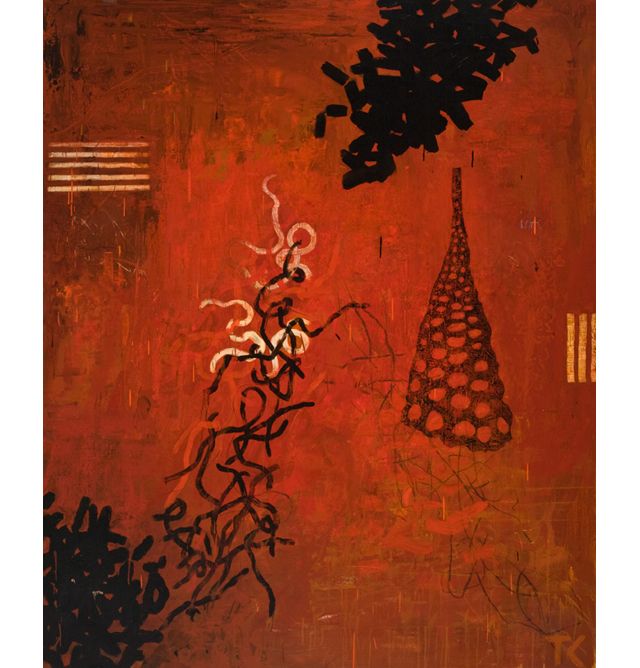
Signal

“Signal” oil, alkyd, and casein on linen
72 X 60 inches

“Signal” compels me in part because of the contrast between the soft edged white and gold shapes against which the fine white and black drawing lines are so delicate and precise.

Posted in Paintings | 1 Comment

Drawing upon Experience

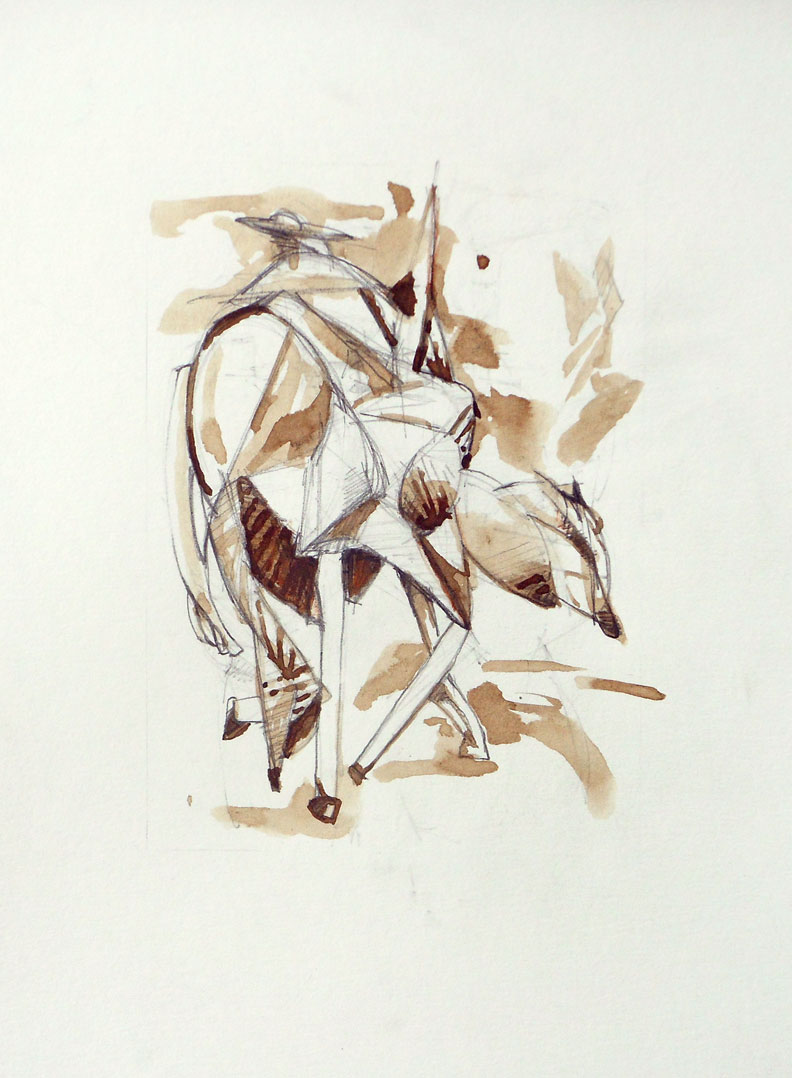
“In Old Mexico”

I’ve created a gallery here for the drawings of The “Man of La Mancha” series, alternatively titled “A.K.A. Don Quixote”. Which is also the working title for a Kickstarter.com project.  More on that later.

Drawing is thinking.

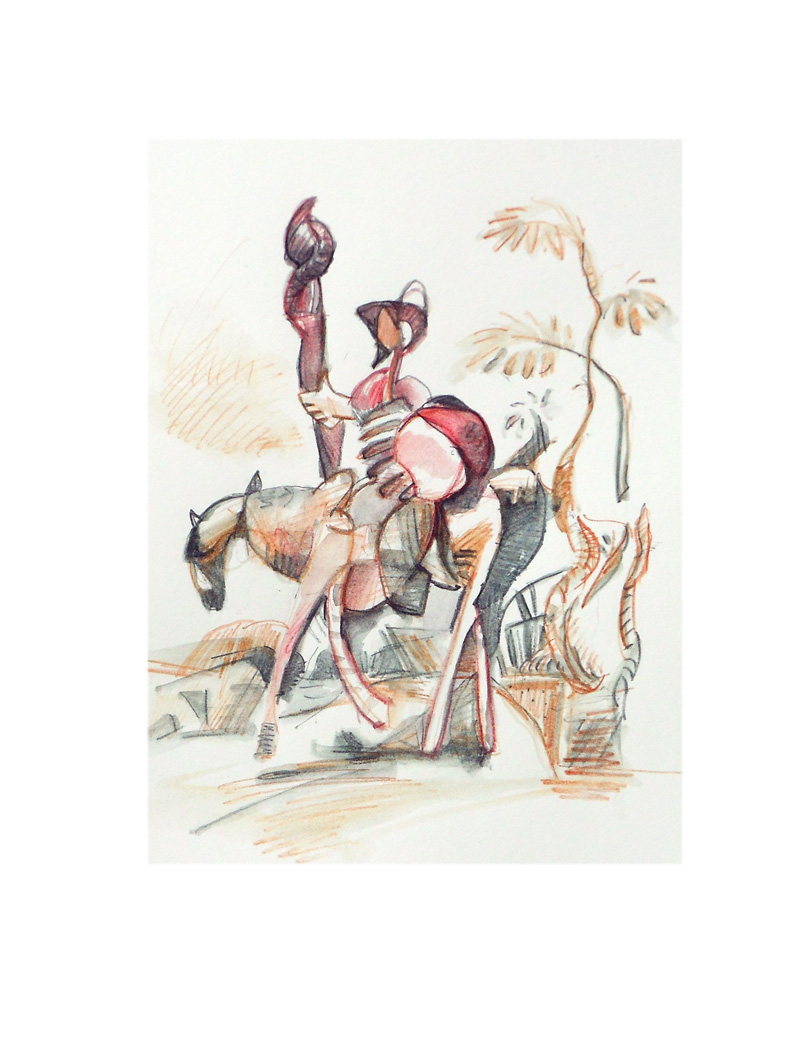
“In the Islands”

“With A Mediterranean Mustache”

Let’s look at these drawings.  The “Leaving La Mancha” paintings were all preceeded by drawing.

Not as in making a drawing and then making a painting from the drawing, but as in thinking through possibilities first by drawing. Just letting your pencil run where the mind goes.

It’s like the classic contour drawing exercise where you fix your eye on a point on an object, and your pencil on the page.  Imagine that your pencil is touching the object at exactly the point that your eye is focused on, and without looking at the paper move the pencil as your eye moves, never losing that exact same contact point: your pencil is touching where your eye is focused.   The point of the exercise is not to make that drawing a beautiful drawing worth keeping, but to develop your eye-hand coordination. It is the equivalent of an athlete running drills. You do it so that when you are in the moment when it matters you will have the skills to do the job without having to stop and think.

Back to the analogy:  You want your pencil to move in sync with what the mind’s eye is seeing just as your pencil touches what your eye sees in the contour drawing lesson.  A doodle, if you will, but a doodle with self awareness. On steroids. With a mission.

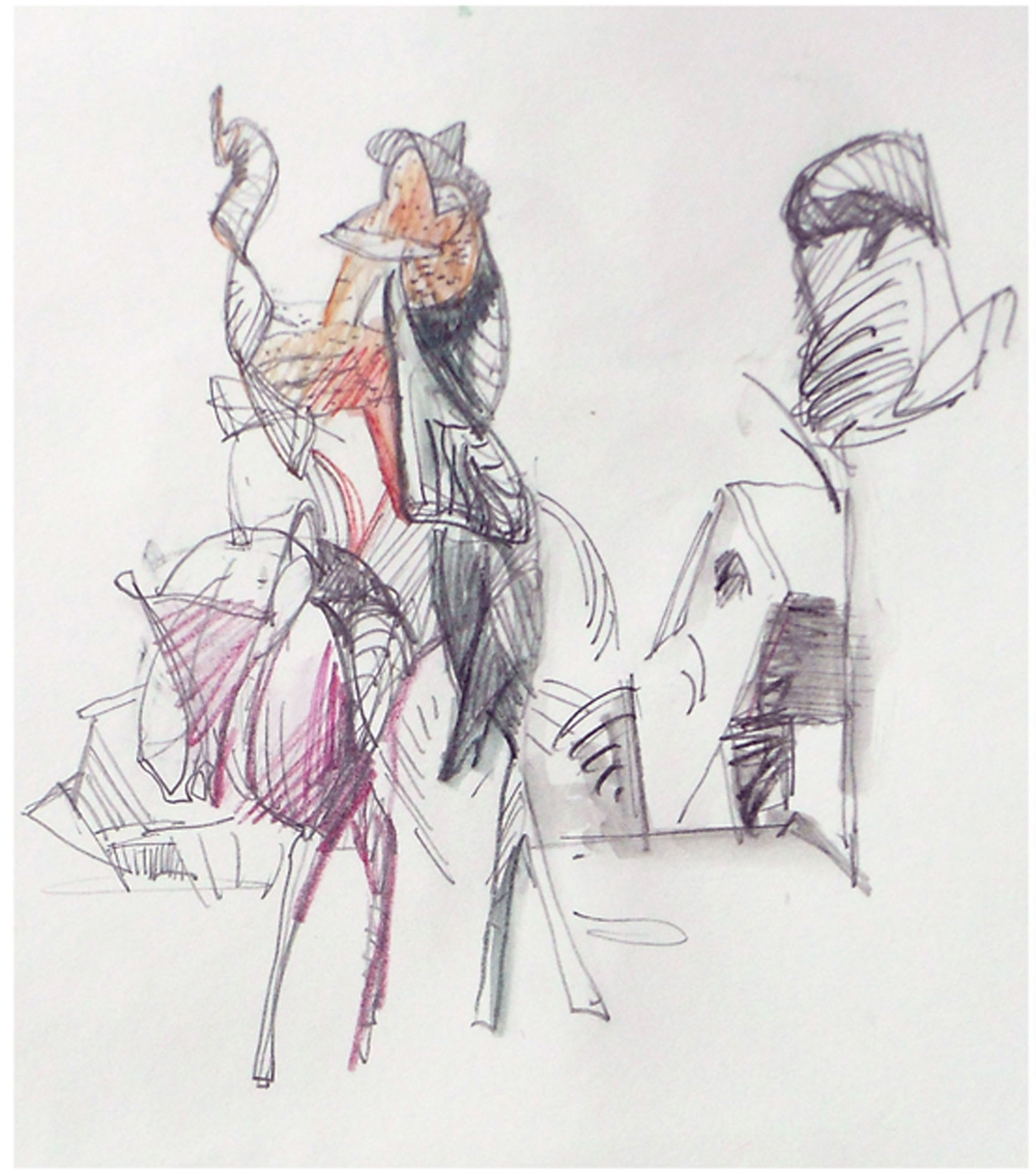
Taking my cue from a love of cubism, I began sketching basic shapes of a guy on a horse, using a funky little welded nuts & nails sculpture of Don Q., and Picasso’s famous sketch or drawing or print, whatever it is, as a disembarkation point. 

As I drew in the lines and shapes of the sculpture, I assembled simple forms representing parts of the figure & horse, and then reassembled them slightly disjointed so they had the appearance of being put together in the back yard with chunks of wood, pieces of tin and balling wire.

This is the earliest drawing I in the group, and in tit you can see how the shapes have been identified, then simplified and exaggerated.

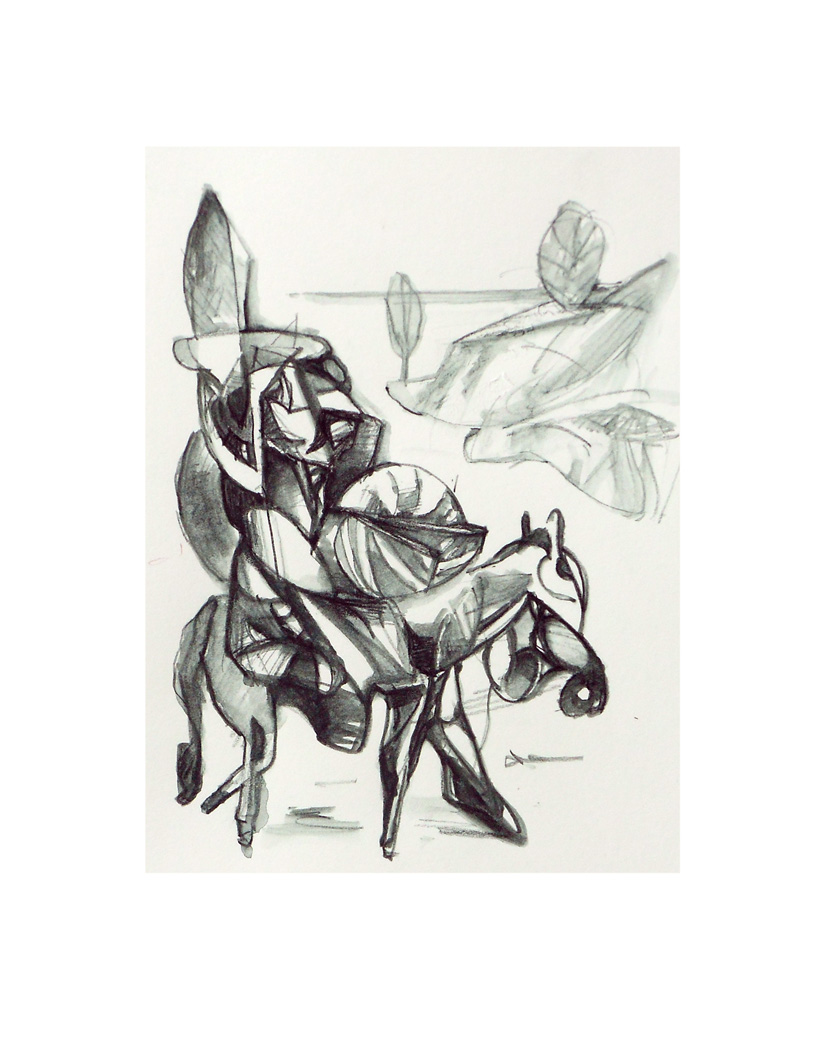
“In a Dusty Town”

I chose a drawing by Watteau of  country houses on a lane, abstracted, as the setting for our protagonist. The abstraction was adapted to fit the drawing of D.Q.: the buildings on the left edge curve upward to complete the arch from the horse’s head up to the spear and helmet, then down to the tail. Those buildings also connect in a line through the back of the horse to the tree in the upper right, forming half on an “X” composition, completed on the other half by the line from the tip of the spear down through the saddle and belly to the end of the leg, lower right.  The horizontal line of the street and the legs splayed out like saw-horses anchor a drawing of swirling lines and diagonals in every direction that could easily go top-heavy and be unsettling.

The simplified shapes of the horse’s head, chest and tail ( which is really not even a shape, just lines), just like D.Q.’s helmet, face and the arm and hand holding the spear, have been drastically simplified.  Abstracted though they may be, every shape in the drawing is still representative of some thing.

Posted in Paintings, Teaching | Tagged , | Leave a comment

The paintings of “Leaving La Mancha”

This gallery contains 18 photos.

Here are (most of) the paintings that are contained in the show: “Leaving La Mancha”. Click on an image for a larger view.  

More Galleries | Tagged | Leave a comment

10 Things from Milton Glaser

I came across this list of 10 Things by Milton Glaser, on the art business blog of Barney Davey.  You can also find it on the Milton Glaser website.  I highly suggest that you read his list in its entirety.   In selecting sections from Glaser’s list I left out huge swatches of sage advise and anecdotes for the sake of space.
Milton Glaser’s best known work has been seen by almost everyone on the planet.  Between the Marlboro cigarette package, the FedEx or UPS logos or the I Love New York logo:
It is hard not to like this:
Ten Things I Have Learned
Part of an AIGA Talk in London

1
YOU CAN ONLY WORK FOR PEOPLE THAT YOU LIKE.

2. IF YOU HAVE A CHOICE NEVER HAVE A JOB.

3. SOME PEOPLE ARE TOXIC AVOID THEM.
… the important thing that I can tell you is that there is a test to determine whether someone is toxic or nourishing in your relationship with them. Here is the test: You have spent some time with this person… Whether you are tired or whether you are exhilarated. If you are more tired then you have been poisoned. If you have more energy you have been nourished. The test is almost infallible and I suggest that you use it for the rest of your life.

4. PROFESSIONALISM IS NOT ENOUGH or THE GOOD IS THE ENEMY OF THE GREAT.
…what professionalism means in most cases is diminishing risks… “please do it in the way that has worked in the past”.  …when you are doing something in a recurring way to diminish risk or doing it in the same way as you have done it before, it is clear why professionalism is not enough. After all, what is required in our field, more than anything else, is the continuous transgression. Professionalism does not allow for that because transgression has to encompass the possibility of failure and if you are professional your instinct is not to fail, it is to repeat success. So professionalism as a lifetime aspiration is a limited goal.

5. LESS IS NOT NECESSARILY MORE.
‘Just enough is more.’

6. STYLE IS NOT TO BE TRUSTED.
I think this idea first occurred to me when I was looking at a marvelous etching of a bull by Picasso. It was an illustration for a story by Balzac called The Hidden Masterpiece. It is a bull that is expressed in 12 different styles going from very naturalistic version of a bull to an absolutely reductive single line abstraction and everything else along the way. What is clear just from looking at this single print is that style is irrelevant. In every one of these cases, from extreme abstraction to acute naturalism they are extraordinary regardless of the style… If you are around for a long time as a(an artist), you have an essential problem of what to do. I mean, after all, you have developed a vocabulary, a form that is your own. It is one of the ways that you distinguish yourself from your peers, and establish your identity in the field. How you maintain your own belief system and preferences becomes a real balancing act. The question of whether you pursue change or whether you maintain your own distinct form becomes difficult.

7. HOW YOU LIVE CHANGES YOUR BRAIN.
The brain is the most responsive organ of the body. Actually it is the organ that is most susceptible to change and regeneration of all the organs in the body… the brain is susceptible, in a way that we are not fully conscious of, to almost every experience of our life and every encounter we have…That is why your mother always said, ‘Don’t hang out with those bad kids.’ Mama was right. Thought changes our life and our behavior. I also believe that drawing works in the same way. I am a great advocate of drawing, not in order to become an illustrator, but because I believe drawing changes the brain in the same way as the search to create the right note changes the brain of a violinist. Drawing also makes you attentive. It makes you pay attention to what you are looking at, which is not so easy.

8. DOUBT IS BETTER THAN CERTAINTY.
Everyone always talks about confidence in believing what you do. I remember once going to a class in yoga where the teacher said that, spirituality speaking, if you believed that you had achieved enlightenment you have merely arrived at your limitation. I think that is also true in a practical sense. Deeply held beliefs of any kind prevent you from being open to experience, which is why I find all firmly held ideological positions questionable…. solving any problem is more important than being right. There is a significant sense of self-righteousness in both the art and design world. Perhaps it begins at school. Art school often begins with the Ayn Rand model of the single personality resisting the ideas of the surrounding culture. The theory of the avant garde is that as an individual you can transform the world, which is true up to a point. One of the signs of a damaged ego is absolute certainty. Schools encourage the idea of not compromising and defending your work at all costs. Well, the issue at work is usually all about the nature of compromise. You just have to know what to compromise.

9. ON AGING.
Last year someone gave me a charming book by Roger Rosenblatt called ‘Ageing Gracefully’ I got it on my birthday. I did not appreciate the title at the time but it contains a series of rules for ageing gracefully. The first rule is the best. Rule number one is that ‘it doesn’t matter.‘ ‘It doesn’t matter what you think. Follow this rule and it will add decades to your life.

10. TELL THE TRUTH.


{A joke}:  A butcher was opening his market one morning and as he did a rabbit popped his head through the door. The butcher was surprised when the rabbit inquired ‘Got any cabbage?’ The butcher said ‘This is a meat market – we sell meat, not vegetables.’ The rabbit hopped off. The next day the butcher is opening the shop and sure enough the rabbit pops his head round and says ‘You got any cabbage?’ The butcher now irritated says ‘Listen you little rodent I told you yesterday we sell meat, we do not sell vegetables and the next time you come here I am going to grab you by the throat and nail those floppy ears to the floor.’ The rabbit disappeared hastily and nothing happened for a week. Then one morning the rabbit popped his head around the corner and said ‘Got any nails?’ The butcher said ‘No.’ The rabbit said ‘Ok. Got any cabbage?’


Posted in Teaching | Tagged | 2 Comments

Is That You, Don Quixote?

Why Don Quixote?  There must be reasons why I chose to take him as my subject matter, my antagonist, my surrogate.  Let’s delve into some background.

Don Quixote At Play

     Don Quixote Approaching the Entrance To the Underworld                                oil paint on canvas, 9″ x 12″, 2012

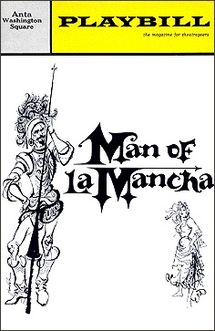
We have all heard of “The Man of La Mancha.” He is the guy who sings:

  “To dream  the impossible dream…!”

In 2001 Rosemary and I bought a house and land in Santa Fe, NM, which we dubbed “La Mancha”, making me: The Man of La Mancha, right?  So, over time we ended up buying a few rather silly welded-nuts-n-bolts sculptures.   Laid up for the summer of 2011, I was looking for a project to occupy myself with, and there he was on the bookshelf:  Don Quixote, Man of La Mancha, all goofy and abstract but still the great wanderer himself, ready for another adventure.

To quote  myself from an artists’ grant application I wrote last summer:

“Don Quixote wanders through the landscapes and the color fields of my paintings, through thickets of pattern and drawing, still believing in the veracity of his visions and the nobility of his cause.  The inveterate impossible dreamer himself is clearly a misguided soul and something of a nuisance.  But is he crazy, a surrealistic performance artist who does battle with everyone he meets, or just a pony-tailed old cynic who can never give up on rock ’n’ roll? My re-imagining is of The Old Man on a swaybacked horse, a long spear at the ready, ever seeking his own truths, ever wandering.

“Delusional though he may be, misinterpreting everything he sees, he is never in doubt.”

As a metaphor for an artist I still think it is quite good.  Pursuing personal visions regardless of what others say is part of our job description.  To continue despite the odds, to swim against the tides, not because of the reward at the end but because it is the battle to get there that is necessary for our creative survival.

Heading for the North Country

     “Don Quixote On the Road”                oil on canvas on panel 10″ x 8″, 2012

Well in April 2012 we sold the house and land. I spent January, February and March 2012 in the house with my dog Scout.  Thus the title of my upcoming exhibit: “Leaving La Mancha.” The show will be (almost) exclusively the paintings I have done this year, either at or since…

leaving La Mancha.  Ready for another adventure.


Posted in Events, Paintings | Tagged , , | Leave a comment

Map to studio

map to studio: 144 Moody Street, Waltham, MA

Posted in Events, Teaching | Leave a comment

Painting lessons in the studio, Summer 2012

PRIVATE PAINTING & DRAWING LESSONS / TUTORING

Learn in the studio of a professional artist: Michael B. Wilson
Lessons will be held in Michael’s studio at 144 Moody Street,    Building 4 (AWA), in Waltham, MA 02453.

Lessons  from building stretchers to shipping to how to talk to galleries, including color, composition, shapes & volumes, blending & brushwork, textures, pattern, mixing color, mediums & solvents, portfolio presentation, and more*.

Customize your classes.  Schedule yourself for one-to-one lessons focused on a subject you want to learn.  For example, color relationships, creating atmosphere, portraits or landscapes from photographs.

Private lessons are $150 for 3 hours.

Packages of 5 private lessons at 3 hours each:  $500

Small group Classes limited to 3 students at a time, 3 hrs once a week: $75 for one lesson, $350 per student for 5 lessons.

Schedule a two – three hour lesson any day of the week, or multiple lessons on a regular basis.   Preferred class times are mornings, Monday – Saturday. Evening classes are available upon request.   Course schedule will be customized to accommodate individual schedules as much as possible. 

Materials  &  Techniques:

  • Brushwork: dry-brush vs. wet-on-wet, descriptive mark-making,
  • Palette-knife painting
  • Glazes and washes: How to use painting mediums

Lessons:

  • The basics: shape and form, line, value, composition, color wheel     
  • How to mix colors
  • How to create textures and patterns
  • Abstraction (How Things Feel, not How they Look)
  • How to paint from photos & Photoshop
  • How to paint landscapes outdoors
  • Sketching in the real world
  • Your idea goes here:______________
Posted in Events, Teaching | Tagged , , , , , , , , , , , , | 2 Comments

gallery opening

Gallery show announcement @ Common Space Gallery, Waltham

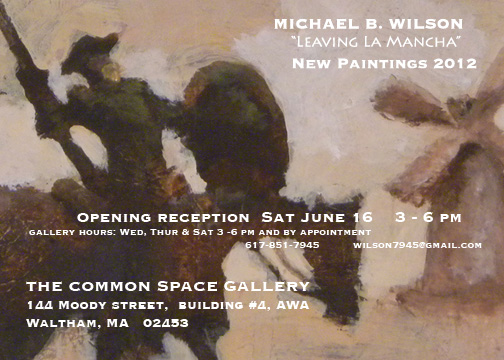
Announcing a “pop-up” show of new paintings at the Artists West Association (AWA) Common Space Gallery. The opening reception will be Saturday June 16 from 3 -6 PM, and yes, you are invited.

“Leaving La Mancha” is a title derived from the recent sale of a magical home and property in New Mexico we were fortunate to have for 11 years.  With that sale came more emotions and changes than I anticipated. The need to be creative became more important than skillfully rendering objects.

“Imagination is more important than knowledge. Knowledge is limited. Imaginationcircles the world.”  Albert Einstein

“Cubist Village Road” 8″ x 10″ oil on canvas on panel

Abstraction brought me the salvation I was seeking. Synthetic cubism, specifically. The things I like most about painting are much more accessible to me Cubistically than Realistically.  I feel completely free and unbound: patterns, brushwork, the emotions of color, bending space, in general being more concerned with creativity and surprising myself as I go than with skillfully rendering things.

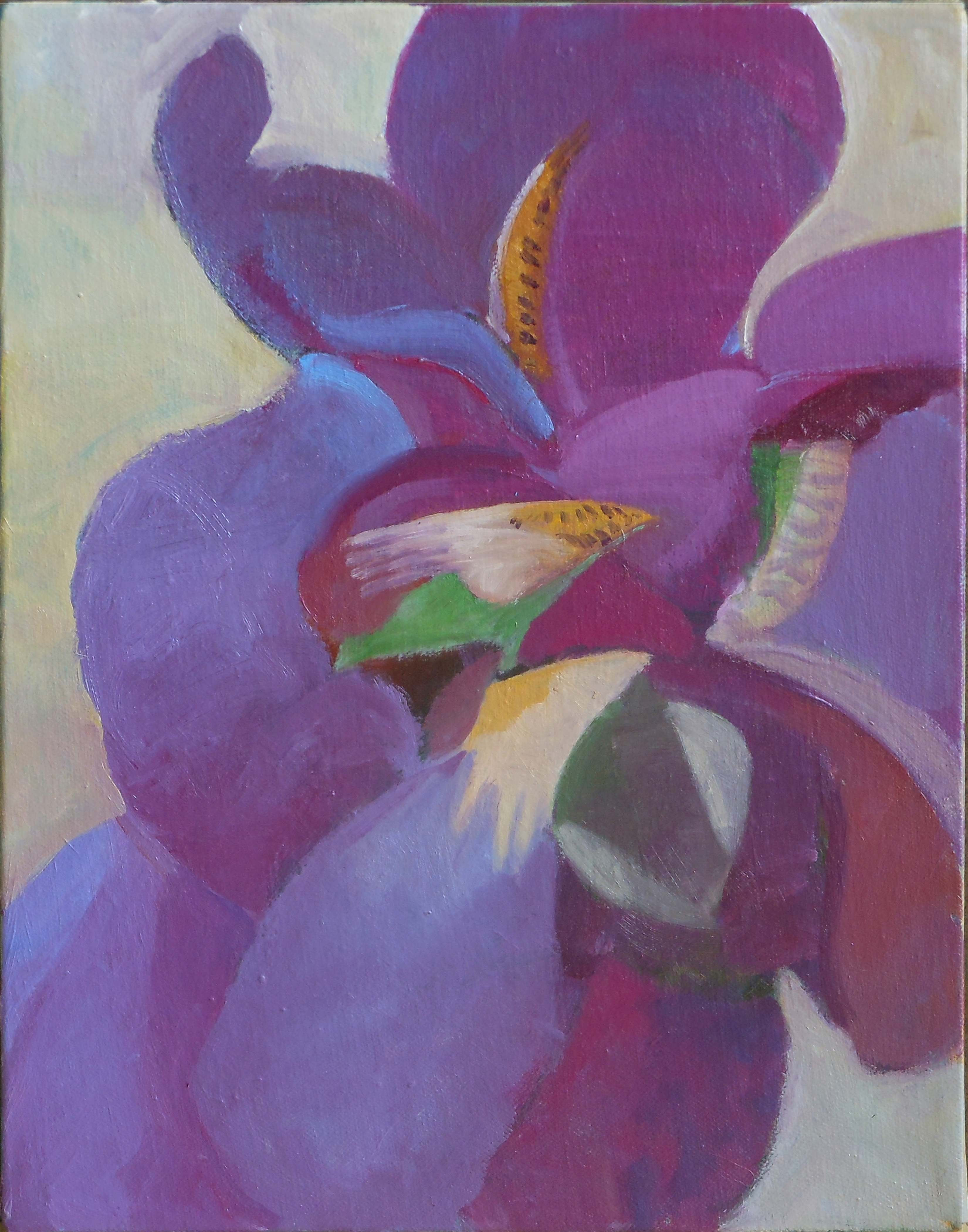
Cubist Purple Iris

“Blood Iris” 14″ x 11″ oil on canvas

“Don Quixote at Dawn” 10″ x 8″ oil on canvas on panel

Saturday, June 16, is also part of the Waltham Riverfest, so there will plenty of art activities around the city to take in. You can find more information about the festivities, such as Art Windows, Paint the River, art exhibit and auction, live music  and more here:

http://walthamriverfest.com/waltham_riverfest_2012_001.htm

Posted in Events | Leave a comment

Mission Statement:

This is a blog about my painting and my teaching.  Here I will showcase new paintings before they go up on the website and when I can or must I might say a little about the process or techniques involved.  I would like to post small paintings that would be auctioned through E-bay on a semi irregular basis.

This is also where I will post news & assignments for the painting classes I teach.

I will also post announcements for exhibits and events: shows, classes, lectures, that kind of thing.  And links to good stuff. Lots of links.

I will begin by referring readers to my website www.michaelbwilson.com. From the paintings you see there you can gather a little background about my work.

A sample:

Posted on by mbwilsonart | 2 Comments